Tag: United Kingdom

UK Announces Updates To CBD Novel Foods Approval Process

A growing body of peer-reviewed scientific research and consumer and patient testimonials has demonstrated that cannabidiol (CBD) is safe for human consumption, and in many cases, that CBD provides several wellness benefits.

Unfortunately, governments and public policies are often not on the same page as researchers, consumers, and patients. Various governments around the world either still prohibit CBD products or greatly hinder their legal availability.

One government that has notably moved slowly on modernizing CBD policies and regulations is the United Kingdom, although regulators in the UK did recently announce some changes and upcoming timelines pertaining to CBD products.

The changes, published today, encourage businesses to meet a CBD provisional acceptable daily intake (ADI) of 10 mg per day of CBD (equivalent to 0.15 mg/kg of body weight per day of CBD for a 70kg adult) and the THC safe upper limit of 0.07 mg THC per day (equivalent to 1 µg/kg of body weight per day of THC for a 70kg adult).” the United Kingdom’s Food Standards Agency stated earlier this week in a news alert.

“The safe upper limit for THC has been agreed based on advice from our independent scientific advisory committees (Opens in a new window), also published today.” the government agency also wrote in its news release.

There are CBD companies in the United Kingdom who were in the middle of the process of gaining government approval to bring their products to the marketplace. Those companies are being afforded the opportunity to reformulate their products in an effort to bring them into compliance with the updated limits.

“The change to guidance encourages compliance with novel food regulations while prioritising public health. Allowing businesses to reformulate their products at this stage will make the authorisation process more efficient, while consumers will benefit from safer CBD products on the market.” stated the UK Food Standards Agency.

“Our pragmatic approach allows businesses to do the right thing for consumer safety while progressing towards full regulatory compliance. This flexibility creates a clearer path forward for CBD businesses while ensuring products meet our safety standards.” said Thomas Vincent of the Food Standards Agency.

A recent market analysis by The Research Insights estimates that “the global cannabidiol market size is projected to be valued at USD 9.14 billion in 2024 and reach USD 22.05 billion by 2030, growing at a CAGR of 15.8%.”

Cannabis Use Associated With “Substantial Improvements” Among OCD Patients

Obsessive-compulsive disorder (OCD) is a serious mental health condition that involves intrusive, unwanted thoughts and obsessions. It also involves repetitive behaviors or compulsions that a person cannot control. OCD can significantly interfere with a patient’s daily tasks, work, and relationships.

International researchers estimate that roughly 2% of the world’s general population suffers from some level of obsessive-compulsive disorder, ranging from mild cases to severe cases. Symptoms include, but are not limited to: a “fear of contamination by dirt or germs; constant checking; repetitive, intrusive thoughts of a somatic, aggressive, or sexual nature; extreme slowness; and an inordinate concern with orderliness and symmetry.”

A team of researchers based in the United Kingdom recently examined medical cannabis use and its impact on patients suffering from obsessive-compulsive disorder. The researchers’ findings were published in the academic journal Psychoactives.

“Existing treatments may not be suitable or effective for all people with OCD, and there is increasing interest in whether these individuals may benefit from the use of cannabis-based medical products (CBMPs).” the researchers stated.

“We document the characteristics of 257 people reporting a diagnosis of OCD within Project T21, a study of medical cannabis patients, and examined whether the use of prescribed cannabinoids improves quality of life. Individuals with OCD were prescribed an average of 2.2 CBMPs, with most products classified as THC-dominant flowers.” the researchers stated about their methodology.

“Three months after initiating treatment, there were substantial improvements in quality of life (Cohen’s d = 0.48; 95% CI = 0.29–0.65), general health (Cohen’s d = 0.43; 95% CI = 0.26–0.61), mood/depression (Cohen’s d = 0.85; 95% CI = 0.65–1.04), and sleep (Cohen’s d = 0.61; 95% CI = 0.43–0.79). There was a corresponding reduction in anxiety symptoms among the subsample who completed the GAD-7 (Cohen’s d = 1.14; 95% CI = 0.84–1.44). Eight individuals (5.7%) reported a total of 14 adverse effects, with the majority of these (57%) being described as mild.” the researchers found.

“Given emerging evidence that those with OCD can benefit from CBMPs, coupled with the increased availability of these unlicensed products internationally, there is a need for more research, including clinical trials, to identify those who may benefit most from the use of these medicines.” the researchers concluded.

Cannabidiol Found To Be An Effective Antifungal Treatment

A team of academic researchers based in Australia and the United Kingdom recently collaborated on a study examining cannabinoids and their ability to be used in antifungal treatment regimens. The researchers found cannabidiol (CBD) and cannabidivarin (CBDV) to be particularly effective.

“Fungal infections pose a major threat to human health with increasing incidence of antifungal resistance globally. Despite the need for novel antifungal drugs, few are currently in clinical development.” the researchers wrote. The study’s findings were published in the academic database PLOS.

The cannabis plant is made up of dozens of cannabinoids, with CBD being a particularly popular cannabinoid in recent years for researchers. CBDV is a lesser-known cannabinoid, and research focused on it is more limited compared to CBD and tetrahydrocannabinol (THC).

“Here we evaluate the antifungal activity of five phytocannabinoids against several clinically relevant fungal pathogens, with a focus on the priority pathogen Cryptococcus neoformans.” the team of researchers stated in their published review. “Our results demonstrate that Cannabidiol (CBD), and particularly Cannabidivarin (CBDV), have broad activity against C. neoformans and other fungal pathogens, including dermatophytes that cause common tinea.”

“We found that both CBD and CBDV acted in a fungicidal manner and prevented biofilm formation in C. neoformans. Phytocannabinoid treatment impeded factors important for virulence and antifungal resistance, including reduced capsule size and disruption of mature biofilms. Proteomics analysis revealed that the antifungal activity of CBD and CBDV was linked to destabilisation of the membrane, alterations in ergosterol biosynthesis, disruption of metabolic pathways, as well as selective involvement of mitochondrial-associated proteins.” they also wrote.

“We next tested the ability of CBD to topically clear a C. neoformans fungal infection in vivo using the Galleria mellonella burn wound model, and we observed greatly improved survival in the CBD treated larvae. This study illustrates the potential of phytocannabinoids as antifungal treatments and opens up new routes towards development of novel antifungal drugs.” the study’s authors concluded.

A recent market analysis by Emergen Research determined that “the Cannabidiol (CBD) Consumer Health Market is expected to grow from USD 20.52 billion in 2024 to an estimated USD 81.76 billion by 2033, at a compound annual growth rate (CAGR) of 16.60%.”

UK Poll Finds Majority Support For Decriminalizing Cannabis

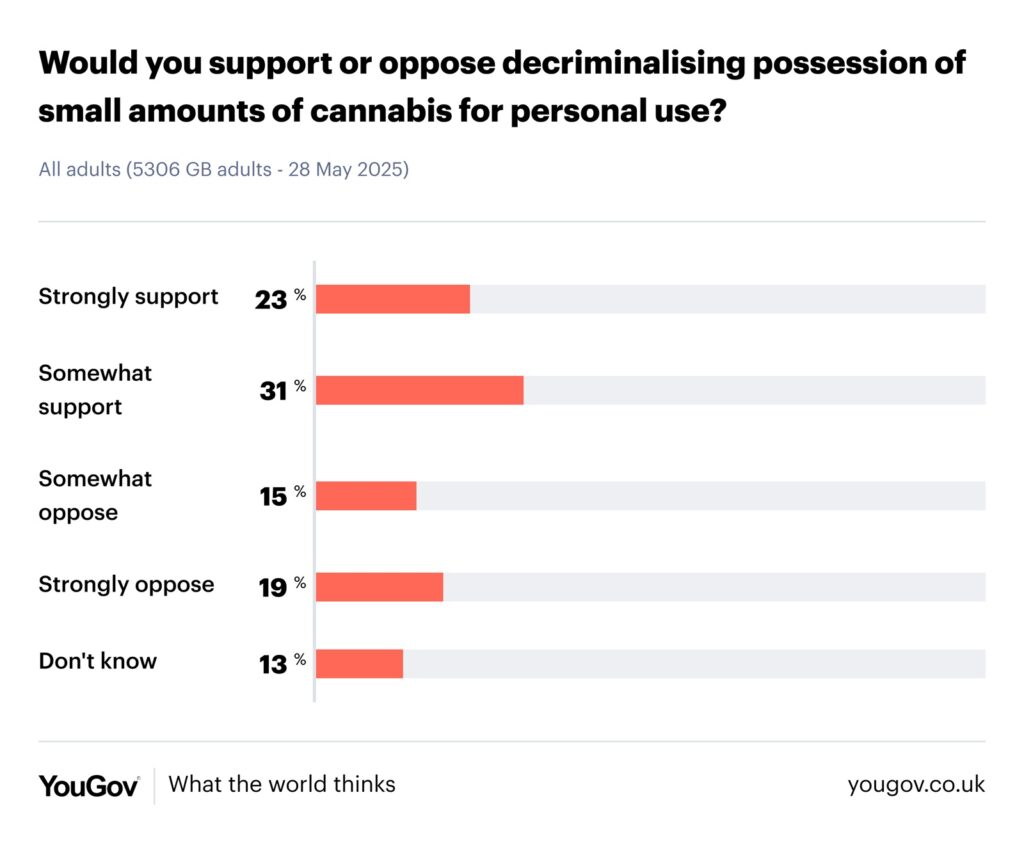
A YouGov UK poll was conducted on May 28th, 2025, the same day that news broke about the London Drugs Commission recommending that cannabis be decriminalized. London Mayor Sir Sadiq Khan, who established the Commission in 2022, quickly endorsed the cannabis decriminalization recommendation.

The YouGov UK poll asked adults in the United Kingdom, “Would you support or oppose decriminalising possession of small amounts of cannabis for personal use?” Below are the results of the poll:YouGov UK Cannabis Decriminalization Poll Results May 28 2025

As you can see from the YouGov UK poll data above, a combined 54% of poll respondents expressed support for the public policy change. Only 34% of poll respondents directly opposed cannabis decriminalization in the United Kingdom, with 13% being undecided.

When the results are filtered by region, support for cannabis decriminalization is even stronger in London, with a combined 56% of survey respondents expressing support for decriminalization, and only 30% of respondents directly opposing it. As is often the case with cannabis policy modernization polls, younger respondents were more likely to support decriminalization compared to older respondents.

“Inclusion of cannabis as a Class B drug in the Misuse of Drugs Act is disproportionate to the harms it can pose relative to other drugs controlled by the Act. The sentencing options currently available, especially for personal possession, cannot be justified when balanced against the longer-term impacts of experience of the justice system, including stop and search, or of serving a criminal sentence can have on a person.” The London Drugs Commission stated about its report earlier this week.

“Sir Sadiq Khan said current rules “cannot be justified”, adding that the commission’s findings had provided “a compelling, evidence-based case” for decriminalisation.” reported BBC in its local coverage.

A previous YouGov UK poll found that the level of support for cannabis legalization among adults in the United Kingdom is greater than the level of support for adult-use legalization among lawmakers.

“The results show that 50% of MPs are opposed to cannabis legalisation when asked in a support/oppose format, compared to 39% who would be in support.” YouGov UK stated about their January 2025 poll results. “The large majority of MPs do, however, believe that doctors should be allowed to prescribe cannabis for medical use (83%). Only 7% are opposed.”

“On the binary question of legalising cannabis, the British public are split, with 45% in favour and 42% opposed, making the public slightly more pro-legalisation than MPs.” YouGov UK also stated.

Adult-use cannabis legalization in the United Kingdom could generate as much as £1.5 billion in revenue and savings, according to a previous report by the advocacy group Transform Drug Policy Foundation.

The report, which was posted on the organization’s social media account back in March, determined that over £1.2 billion would be generated from taxes and fees annually, and an additional £284 million would be saved annually by the nation’s criminal justice system no longer enforcing cannabis prohibition policies.

“There would be costs incurred for Govt by regulatory infrastructure – inspection, monitoring, compliance, trading standards etc – but largely covered by licensing/other fees.” the organization stated on social media.

Transform Drug Policy Foundation also determined that “up to 15,500 full-time jobs could be created in cultivation, manufacturing, retail & related services, (depending on the model implemented).”

The report also found that “a regulated market could displace 80% of the illegal trade in five years (based on trends in Canada).” The organization’s proposed legalization model involves permitting home cultivation, cultivation associations, and a government retail monopoly.

A separate analysis published last year by UK-based advocacy group CLEAR determined that legalizing cannabis for adult use in the United Kingdom and taxing and regulating sales could generate as much as £9.5 billion per year based on their proposed model.

UK Epilepsy Patients Improve Following Medical Cannabis Therapy

A growing list of peer-reviewed studies and personal medical cannabis patient testimonials demonstrates that cannabis is medicine, and it can be effectively used to treat a wide range of health conditions.

Suffering patients of one serious health condition in particular, epilepsy, seem to greatly benefit from the incorporation of medical cannabis therapies in treatment regimens. Epilepsy patients from around the globe have reportedly experienced dramatic improvements following medical cannabis use.

A team of researchers in the United Kingdom recently conducted a study involving patients with treatment-resistant epilepsy and medical cannabis, and the results of their research found that the patients experienced significant improvements. Below is more information about the study via a news release from NORML:

London, United Kingdom: Patients with refractory epilepsy report sustained improvements in their symptoms following the use of medical cannabis preparations, according to observational data published in the journal Brain and Behavior.

British investigators assessed the use of cannabis-based medicinal products (CBMPs) in a cohort of 134 patients with treatment-resistant epilepsy. (British health care providers may prescribe cannabis-based medicinal products to patients unresponsive to conventional medications.) Patients’ outcomes were assessed at one, three, and six months.

Medical cannabis treatment was associated with improvements in patient‐reported epilepsy‐specific outcomes, alongside improvements in anxiety, sleep quality, and health-related quality of life. Over 96 percent of study subjects reported no adverse events from cannabis treatment.

“Treatment with CBMPs was associated with an improvement in both epilepsy‐specific and general HRQoL [health-related quality of life] outcomes at one, three, and six months,” the study’s authors concluded. “This study shows the promising potential of CBMPs as an adjunctive treatment option in the management of TRE [treatment-resistant epilepsy.]”

In 2018, regulators at the US Food and Drug Administration granted market approval to Epidiolex, a prescription medicine containing a standardized formulation of plant-derived cannabidiol (CBD) for the treatment of two rare forms of epilepsy: Lennox-Gastaut syndrome and Dravet syndrome.

Other observational studies assessing the use of cannabis products among those enrolled in the UK Medical Cannabis Registry have reported them to be effective for patients diagnosed with cancer-related painanxietyfibromyalgiainflammatory bowel diseasehypermobility disordersdepressionmigrainemultiple sclerosisosteoarthritis, and inflammatory arthritis, among other conditions.

Full text of the study, “UK Medical Cannabis Registry: A clinical outcomes analysis for epilepsy,” appears in Brain and Behavior. Additional information on cannabis and epilepsy is available from NORML’s publication, Clinical Applications for Cannabis & Cannabinoids.

PTSD Patients Experience Sustained Improvements After Medical Cannabis Use

International health researchers estimate that roughly 4% of the world’s total population suffers from some form of post-traumatic stress disorder (PTSD). PTSD is one of the most common mental health conditions around the globe.

PTSD is typically treated via several different therapies, with common examples including different types of trauma-focused psychotherapy as well as pharmaceutical medications. Many of the pharmaceutical medications commonly used to treat PTSD can yield undesirable side effects.

A recent study conducted in the United Kingdom examined medical cannabis therapies and PTSD, with the researchers finding that the study’s subjects experienced sustained improvements following medical cannabis use. Below is more information about the study and its results via a news release from NORML:

London, United Kingdom: Patients diagnosed with post-traumatic stress experience significant long-term benefits following their use of medical cannabis preparations, according to data published in the journal Expert Review of Neurotherapeutics.

British researchers assessed changes in patients’ health-related quality of life (HRQoL) following the use of cannabis-based medicinal products (CBMPs). (British health care providers may prescribe cannabis-based medicinal products to patients unresponsive to conventional medications.) Two hundred and sixty-nine patients with post-traumatic stress enrolled in the United Kingdom’s  Medical Cannabis Registry were enrolled in the trial. Participants’ symptoms were assessed at 1, 3, 6, 12, and 18 months.

Consistent with other observational studies, “significant improvements in post-traumatic stress symptoms, anxiety, sleep quality, and HRQoL were observed at all follow-up points.” Symptomatic improvements were sustained for the entire study period (18 months).

Other observational studies assessing the use of cannabis products among patients enrolled in the UK Medical Cannabis Registry have reported them to be effective for those diagnosed with cancer-related painanxietyfibromyalgiainflammatory bowel diseasehypermobility disordersdepressionmigrainemultiple sclerosisosteoarthritis, and inflammatory arthritis, among other conditions.

Full text of the study, “UK Medical Cannabis Registry: An updated clinical outcomes analysis of patients with post-traumatic stress disorder,” appears in Expert Review of Neurotherapeutics. Additional information on cannabis and post-traumatic stress is available from NORML’s publication, Clinical Applications for Cannabis & Cannabinoids.

Hypermobility Disorder Patients Report Improvements Following Cannabis Use

Hypermobility disorders are serious health conditions involving excessive joint flexibility and instability. Examples include hypermobile Ehlers-Danlos syndrome (hEDS) and hypermobility spectrum disorders (HSD). The conditions often involve the patient suffering from pain, injuries, and other symptoms.

According to researchers affiliated with the University of Edinburgh, “General Joint Hypermobility is a common condition found in 2–57% of the population.” For Ehlers-Danlos syndrome specifically, the rate is about 1 in 5000 people.

A separate team of researchers based in the United Kingdom recently conducted a study examining patients diagnosed with hypermobility disorders and their use of medical cannabis therapies. Below is more information about the research and its results via a news release from NORML:

London, United Kingdom: Patients suffering from hypermobility disorders report sustained symptomatic improvements following their use of cannabis-based medicinal products (CBMPs), according to observational data published in the journal of the American College of Rheumatology, ACR Open Rheumatology.

British researchers assessed the use of botanical cannabis or oil extracts in 161 patients with Ehlers-Danlos syndrome or similar hypermobility disorders enrolled in the UK Medical Cannabis Registry. (British specialists may prescribe cannabis-based medicinal products to patients unresponsive to conventional medications.) Researchers assessed changes from baseline in patient-reported outcomes at one, three, six, 12, and 18 months.

Patients reported sustained improvements in pain-specific metrics, as well as improvements in sleep and anxiety following cannabis therapy. The most reported adverse effects associated with  cannabis treatment were headache and lethargy.

“This case series found improvements in perceived pain severity and interference, general HRQoL [health-related quality of life], sleep quality, and anxiety in patients with HSD [hypermobility spectrum disorder] or hEDS [hypermobile Ehlers-Danlos syndrome] after CBMP prescription,” the study’s authors concluded. “At 18 months, between 18.01 percent and 25.47 percent of individuals reported a clinically significant improvement in their pain depending on the assessment measure used. … [T]hese findings may help guide current clinical practice and shared decision‐making between patients and physicians.”

Other observational studies assessing the use of cannabis products among patients enrolled in the UK Cannabis Registry have reported them to be effective for those diagnosed with cancer-related painanxietyfibromyalgiainflammatory bowel diseasepost-traumatic stressdepressionmigrainemultiple sclerosisosteoarthritis, and inflammatory arthritis, among other conditions.

Full text of the study, “UK Medical Cannabis registry: An analysis of outcomes of medical cannabis therapy for hypermobility-associated chronic pain,” appears in ACR Open Rheumatology.

84% Of Polled UK Doctors ‘Open To Prescribing Cannabis For Chronic Pain’

According to the results of a recent survey commissioned by medical cannabis clinic Alternaleaf, 84% of polled UK doctors indicated that they would be open to prescribing cannabis for chronic pain if it was part of the NHS toolkit.

“The survey of 250 practicing doctors in the UK, commissioned by the medical cannabis clinic Alternaleaf, found that eight in 10 (78%) believe opioids are prescribed too frequently for pain relief, while one in three say the NHS is not prepared for the dramatic increase in patients predicted.” reported Cannabis Health News in its original coverage.

“An early economic analysis published last year found that prescribing cannabis-based medicines for chronic pain could save the NHS almost £4 billion annually (based on current prevalence rates).” the outlet also reported.

A separate report recently published by the advocacy group Transform Drug Policy Foundation found that adult-use cannabis legalization could generate as much as £1.5 billion in revenue and savings.

The report, which was posted on the organization’s social media account, determined that over £1.2 billion would be generated from taxes and fees annually, and an additional £284 million would be saved annually by the nation’s criminal justice system no longer enforcing cannabis prohibition policies.

“There would be costs incurred for Govt by regulatory infrastructure – inspection, monitoring, compliance, trading standards etc – but largely covered by licensing/other fees.” the organization stated on social media.

UK Cannabis Legalization Could Yield £1.5 Billion Annually

Adult-use cannabis legalization could generate as much as £1.5 billion in revenue and savings according to a new report by the advocacy group Transform Drug Policy Foundation.

The report, which was posted on the organization’s social media account, determined that over £1.2 billion would be generated from taxes and fees annually, and an additional £284 million would be saved annually by the nation’s criminal justice system no longer enforcing cannabis prohibition policies.

“There would be costs incurred for Govt by regulatory infrastructure – inspection, monitoring, compliance, trading standards etc – but largely covered by licensing/other fees.” the organization stated on social media.

Transform Drug Policy Foundation also determined that “up to 15,500 full-time jobs could be created in cultivation, manufacturing, retail & related services, (depending on the model implemented).”

The report also found that “a regulated market could displace 80% of the illegal trade in five years (based on trends in Canada).” The organization’s proposed legalization model involves permitting home cultivation, cultivation associations, and a government retail monopoly.

A previous analysis published last year by UK-based advocacy group CLEAR determined that legalizing cannabis for adult use in the United Kingdom and taxing and regulating sales could generate as much as £9.5 billion per year based on their proposed model.